Terraform AWS Provider v6: Redesigning API Gateway for Multi-Team Ownership
Initially when we first designed our AWS API Gateway setup, the goal was simple, one custom domain, one REST API, and a top-level path-based routing strategy to serve multiple teams. It worked. Teams were onboarded quickly, routing was predictable, and the Terraform was easy to understand. For a while, it was the right call.
Then the HashiCorp AWS Terraform provider v6 landed and with it, the removal of stage_name from aws_api_gateway_deployment. What started as a migration task turned into something more valuable, a forcing function to rethink our architecture from the ground up and give each team ownership of their own API.
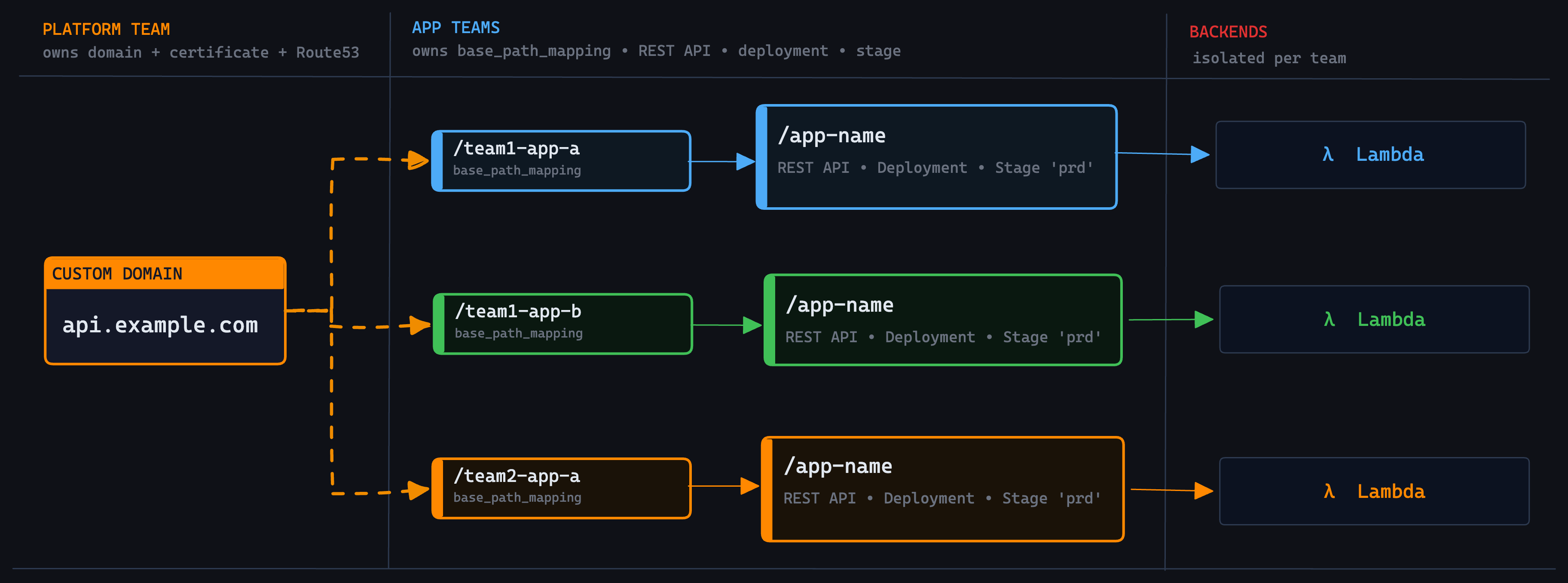
Table of Contents
How We Started: One API, One Stage, One Domain
Our original setup was deliberately simple. We had a single aws_api_gateway_rest_api shared across all teams, deployed to a single stage, and exposed through one custom domain. Teams used top-level path prefixes — /{team}-{app-name} to carve out their own routes within the shared API.
api.example.com
    └── base path: /  →  shared REST API  →  "prd" stage
                               │
                     ┌─────────┼──────────┐
              /team1-app-a   /team1-app-b   /team2-app-a
This used to work because the stage_name in aws_api_gateway_deployment resource implicitly created or updated an API gateway stage. So for example the below configuration would create a deployment, automatically create a stage named prd and associate to that deployment(if it didn't already exist) or update the stage to point to the new deployment (if it already existed).
resource "aws_api_gateway_deployment" "example" {
  rest_api_id = aws_api_gateway_rest_api.default.id
  stage_name  = "prd"
}
What Changed in Provider v6
In the v6 upgrade, the stage_name and related attributes were removed from the aws_api_gateway_deployment resource. This means that deployments no longer automatically create or update stages. Instead, stages must be managed explicitly using the aws_api_gateway_stage resource.
resource "aws_api_gateway_deployment" "example" {
  rest_api_id = aws_api_gateway_rest_api.default.id
}

resource "aws_api_gateway_stage" "prd" {
  stage_name    = "prd"
  rest_api_id   = aws_api_gateway_rest_api.default.id
  deployment_id = aws_api_gateway_deployment.example.id
}
This is a nice improvement since stages now have explicit lifecycle management, but it also means that our previous architecture of a single shared API with a single stage is no longer viable. We had to rethink our design to give each team ownership of their own API and stage.
The New Architecture: Per-Team APIs Behind a Shared Custom Domain
The new refactored design splits ownership along a clean boundary. The platform team owns the custom domain and each app team owns their REST API, deployment, and stage. The connection between them is a aws_api_gateway_base_path_mapping resource per team, a thin explicit wire between two independently managed resources.
api.example.com
    ├── /team1-app-a  →  Team1-App-A REST API  →  "prd" stage
    ├── /team1-app-b  →  Team1-App-B REST API  →  "prd" stage
    └── /team2-app-a  →  Team2-App-A REST API  →  "prd" stage
From the outside, the API surface is identical. From the inside, each team is fully isolated.
Terraform Implementation
Platform Team:
The platform team provisions the ACM certificate, handles DNS validation, creates the custom domain, and creates the Route 53 alias record. The domain_name is then exposed as an output and passed into usecase team modules as a variable.
locals {
  api_domain = "api.example.com"

  api_gateway = {
    domain_name = aws_api_gateway_domain_name.default.domain_name
  }
}

# CloudWatch integration role for API Gateway logging
module "cloudwatch_integration_role" {
  source  = "schubergphilis/mcaf-role/aws"
  version = "~> 0.5.3"

  name                  = "ApiGatewayCloudWatchIntegration"
  policy_arns           = ["arn:aws:iam::aws:policy/service-role/AmazonAPIGatewayPushToCloudWatchLogs"]
  principal_type        = "Service"
  principal_identifiers = ["apigateway.amazonaws.com"]
  tags                  = var.tags
}

resource "aws_api_gateway_account" "default" {
  cloudwatch_role_arn = module.cloudwatch_integration_role.arn
}

# ACM Certificate with DNS validation
resource "aws_acm_certificate" "api" {
  domain_name       = local.api_domain
  validation_method = "DNS"
  tags              = var.tags

  lifecycle {
    create_before_destroy = true
  }
}

resource "aws_route53_record" "api_cert_validation" {
  for_each = {
    for dvo in aws_acm_certificate.api.domain_validation_options : dvo.domain_name => {
      name   = dvo.resource_record_name
      record = dvo.resource_record_value
      type   = dvo.resource_record_type
    }
  }

  name    = each.value.name
  records = [each.value.record]
  ttl     = 60
  type    = each.value.type
  zone_id = var.route53_zone_id
}

resource "aws_acm_certificate_validation" "api" {
  certificate_arn         = aws_acm_certificate.api.arn
  validation_record_fqdns = [for record in aws_route53_record.api_cert_validation : record.fqdn]
}

# Custom domain — the single shared entry point
resource "aws_api_gateway_domain_name" "default" {
  domain_name              = aws_acm_certificate.api.domain_name
  regional_certificate_arn = aws_acm_certificate_validation.api.certificate_arn
  security_policy          = "TLS_1_2"
  tags                     = var.tags

  endpoint_configuration {
    types = ["REGIONAL"]
  }
}

# Route 53 alias pointing to the API Gateway regional domain
resource "aws_route53_record" "api" {
  name    = aws_api_gateway_domain_name.default.domain_name
  zone_id = var.route53_zone_id
  type    = "A"

  alias {
    evaluate_target_health = true
    name                   = aws_api_gateway_domain_name.default.regional_domain_name
    zone_id                = aws_api_gateway_domain_name.default.regional_zone_id
  }
}

# Expose domain_name for usecase teams to consume
output "api_domain" {
  value       = local.api_domain
  description = "The API gateway domain name"
}
The key output here is api_domain. This is the only thing app teams need from the platform, they receive it as a variable input and use it to register their base path mapping.
App Teams:
Each app team owns their own REST API, resources, methods, integrations, deployment, stage, and base path mapping. The only dependency on the platform team is var.api_domain.
# Each team's own REST API
resource "aws_api_gateway_rest_api" "default" {
  name = "team1-app-a-api"
  tags = var.tags

  endpoint_configuration {
    types = ["REGIONAL"]
  }

  lifecycle {
    create_before_destroy = true
  }
}

# API resources and routing
resource "aws_api_gateway_resource" "root" {
  rest_api_id = aws_api_gateway_rest_api.default.id
  parent_id   = aws_api_gateway_rest_api.default.root_resource_id
  path_part   = "app-name"
}

resource "aws_api_gateway_resource" "proxy" {
  rest_api_id = aws_api_gateway_rest_api.default.id
  parent_id   = aws_api_gateway_resource.root.id
  path_part   = "{proxy+}"
}

resource "aws_api_gateway_method" "default" {
  rest_api_id   = aws_api_gateway_rest_api.default.id
  resource_id   = aws_api_gateway_resource.proxy.id
  http_method   = "ANY"
  authorization = "NONE"
}

resource "aws_api_gateway_integration" "default" {
  rest_api_id             = aws_api_gateway_rest_api.default.id
  resource_id             = aws_api_gateway_resource.proxy.id
  http_method             = aws_api_gateway_method.default.http_method
  integration_http_method = "POST"
  type                    = "AWS_PROXY"
  uri                     = "arn:aws:apigateway:${data.aws_region.current.name}:lambda:path/2015-03-31/functions/${var.lambda_function_arn}/invocations"
}

# Deployment — triggers on actual resource/method/integration changes only
resource "aws_api_gateway_deployment" "default" {
  rest_api_id = aws_api_gateway_rest_api.default.id
  description = "Deployment of team1-app-a-api"

  triggers = {
    redeployment = sha1(jsonencode([
      aws_api_gateway_resource.root,
      aws_api_gateway_resource.proxy,
      aws_api_gateway_method.default,
      aws_api_gateway_integration.default,
    ]))
  }

  lifecycle {
    create_before_destroy = true
  }
}

# Stage explicitly managed
resource "aws_api_gateway_stage" "default" {
  stage_name    = "prd"
  rest_api_id   = aws_api_gateway_rest_api.default.id
  deployment_id = aws_api_gateway_deployment.default.id
  tags          = var.tags
}

# Base path mapping, wires this team's stage to the shared custom domain
resource "aws_api_gateway_base_path_mapping" "default" {
  api_id      = aws_api_gateway_rest_api.default.id
  base_path   = "team1-app-a"
  domain_name = var.api_domain
  stage_name  = aws_api_gateway_stage.default.stage_name
}
The base_path team1-app-a is what gives each team their unique path on the shared custom domain. A request to api.example.com/team1-app-a/app-name/... routes exclusively to this team's REST API and Lambda. The single variable var.api_domain is the entire contract between the platform and app teams. Everything else API resources, methods, integrations, deployments, stages are fully owned and independently deployable by each team.
Final Thoughts
We went into this as a compliance task to update the provider, fix the deprecation, and move on. We came out of it with a meaningfully better architecture that we should have built earlier.
The stage_name removal in AWS provider v6 is a small change on the surface, but it draws a clear line that stages should be explicit resources with their own lifecycle. Once you accept that, it is a short step to asking why multiple teams should share that lifecycle at all.
If you are running a multi-team setup on a shared API Gateway and have been putting off this kind of refactor, the v6 migration is as good a reason as any to do it properly.